Why We Keep Avoiding the Question
We tend to think of fundamentalism as a religious phenomenon—the domain of zealots, extremists, people who take ancient texts too literally. But fundamentalism is not about religion. It is about closed narrative.
And right now, America is building two of them.
A fundamentalism is any story that cannot be questioned, cannot be revised, cannot encounter the specific instance without forcing it into the pre-existing frame. It is a narrative so hardened that it no longer describes reality—it replaces reality. The story becomes more real than the person standing in front of you.
Every human being operates through stories. We have to. The world is too complex to encounter raw. We need categories, patterns, shorthand. The question is not whether we use stories to navigate reality, but whether those stories remain soft enough to be revised when reality pushes back—or whether they have calcified into something that reality can no longer touch.
The difference between a functioning story and a fundamentalism is simple: Can you still see the specific person, or do you only see the category?
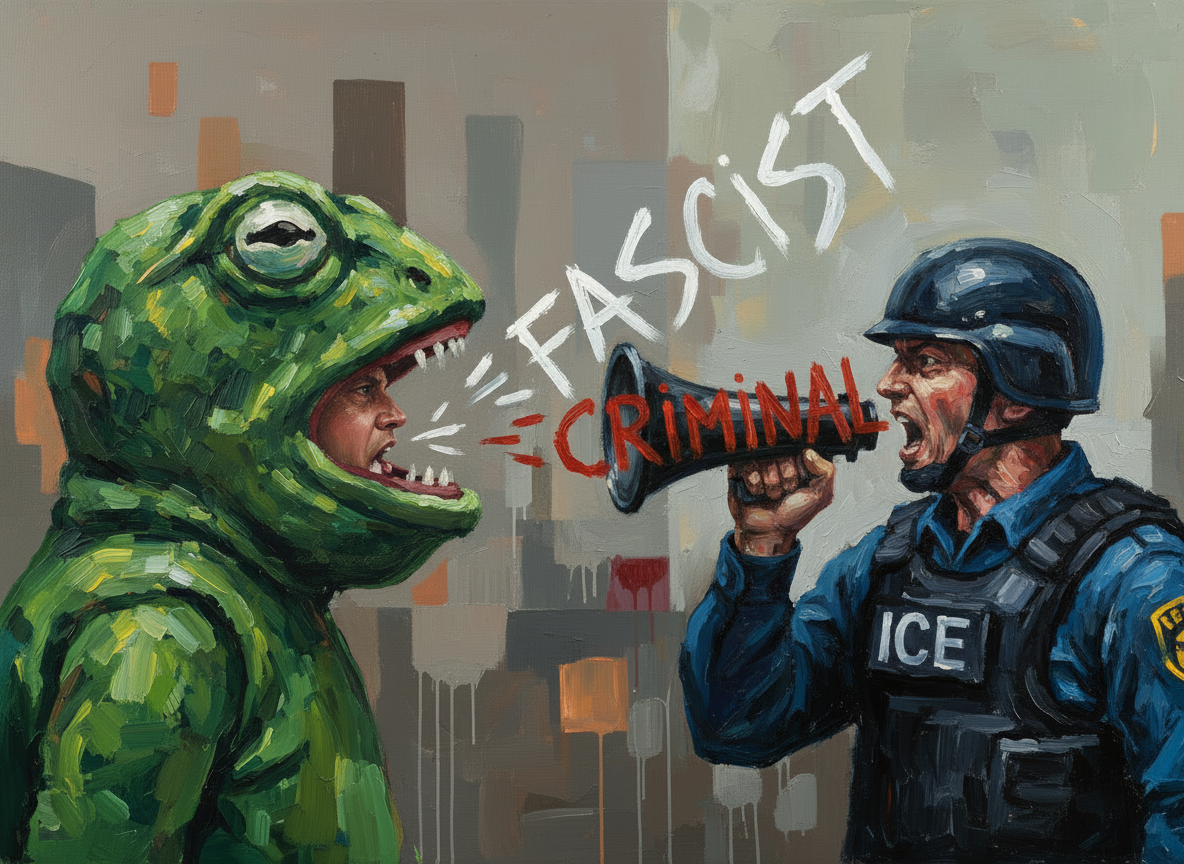
When you can no longer see the person—when the immigrant is only “invader” or only “victim,” when the officer is only “fascist” or only “hero,” when your neighbor is only “red” or “blue”—you have crossed into fundamentalism. You are no longer in a political disagreement. You are in a religious war. And religious wars do not end through policy. They end through exhaustion, separation, or violence.
The Current Landscape: Propaganda and Narrative
As of early 2026, approximately 70,000-73,000 people are held in U.S. immigration detention—the highest number in ICE’s history, an 84% increase from the same time last year. The administration has stated its goal is to reach capacity for 100,000 detainees. Meanwhile, an estimated 11-14 million undocumented people live in the United States.
| Metric | Current Estimate (Early 2026) | Historical Context |
|---|---|---|
| ICE Detainees | ~73,000 | Highest ever (prev. high was ~55k in 2019) |
| Growth Rate | ~84% increase | Compared to ~39,000 in early 2025 |
| Admin Goal | 100,000+ beds | Backed by the “One Big Beautiful Bill Act” |
| Total Undocumented | 11–14 million | PEW (14M) vs. DHS (11M) |
| Primary Hubs | CA, TX, NY, IL, FL | Major cities report severe budget/service strain |
These are facts. They are not in dispute.
The 11-14 million are not dispersing to Wyoming or the Dakotas. Data from the Center for Migration Studies and Pew shows that approximately 42-45% of the undocumented population resides in just two states: California and Texas. The vast majority live in major metropolitan hubs. Cities like New York, Chicago, and Denver have declared states of emergency or requested federal aid specifically citing “strained service capacity” in hospitals, schools, and housing. Meanwhile, states like Wyoming, Vermont, and the Dakotas continue to have the lowest immigrant populations in the country—often less than 2-3% of their total population.
This is a real problem. It requires real policy. The concentration in already-strained cities creates genuine challenges that cannot be wished away.
What is in dispute is what story we tell about these facts.
The Propaganda
The progressive narrative frames detention as state violence against vulnerable populations. A viral meme recently noted that the U.S. currently holds three times as many people in immigration detention as were held in Nazi concentration camps in spring 1939. This is technically accurate—the Nazi system held approximately 21,000 prisoners at that specific moment, before the war began and the camps expanded into instruments of genocide.
The comparison is factually correct. It is also rhetorically designed to bypass thought. By invoking Nazis, it collapses the moral complexity of immigration enforcement into a single frame: this is genocide, or proto-genocide, and anyone who supports any enforcement is complicit. The narrative forecloses the possibility that enforcement could be legitimate while methods could be wrong. It demands total opposition.
The conservative narrative frames undocumented immigration as invasion. Millions of people crossing borders illegally, straining public services, changing the cultural character of communities, and—in the most extreme tellings—bringing crime, drugs, and deliberate demographic replacement.
This narrative also contains factual elements. The numbers are real. The strain on certain cities is real. The economic and social challenges are real. But the framing transforms policy failure into existential threat. It demands not reform but expulsion. It makes the immigrant into a category—”illegal”—that strips away the specific person, circumstances, and the humanity.
Both narratives do the same thing: they take a complex reality and flatten it into a story that requires no thought, only alignment. You pick your side, repeat the narrative, and then you stop seeing.
What the Last Decade Has Really Been About
But what if the immigration debate isn’t really about immigration at all?
Ferguson, Missouri. August 2014. Michael Brown, an unarmed Black teenager, was shot and killed by Officer Darren Wilson. What followed wasn’t just protest—it was an uprising. Military vehicles rolled through American streets. Police in combat gear faced citizens. The National Guard was deployed against Americans.
The official debate was about whether the shooting was justified. But look at what people were actually responding to: decades of predatory policing, of a municipal court system that funded itself through fines levied disproportionately on Black residents, of traffic stops that turned into searches, of force applied casually and constantly to certain bodies and not others. The shooting was the spark. The force was the fuel.
Baltimore, Maryland. April 2015. Freddie Gray was arrested for possessing a knife. By the time the transport van reached the police station, his spine was 80% severed at the neck. He died a week later.
The protests that followed, the fires, the National Guard—again. The official debate was about whether the officers were guilty of murder. But the underlying issue was the “rough rides”—a known practice of injuring suspects during transport. Force applied to bodies, unaccountable, normalized.
Standing Rock, North Dakota. 2016. The Standing Rock Sioux Tribe and thousands of supporters protested the Dakota Access Pipeline. Private security used attack dogs on protesters. Police used water cannons in subfreezing temperatures. Rubber bullets. Concussion grenades.
The official debate was about environmental policy, tribal sovereignty, eminent domain. But look at the images: militarized response to people standing on land they claimed was theirs. Force. Applied to bodies. With no accountability.
Charlottesville, Virginia. August 2017. White supremacists marched with torches. Counter-protesters showed up. Heather Heyer was killed when a car drove into the crowd.
The official debate was about free speech, about “both sides,” about the statue of Robert E. Lee. But underneath: who gets to assemble? Who gets protected? When force arrived, whose bodies did it shield and whose did it target?
Minneapolis, Minnesota. May 2020. George Floyd was killed when Officer Derek Chauvin knelt on his neck for nine minutes and twenty-nine seconds, while Floyd said “I can’t breathe” and bystanders pleaded for his life.
The whole world watched the video. There was no ambiguity about what force looked like. A man died under a knee, slowly, while other officers stood guard. The protests that followed were the largest in American history. Cities burned. The National Guard deployed in dozens of states.
The official debate became about “defunding the police,” about property damage, about looting. But the protest signs said the same thing they’d said in Ferguson six years earlier: stop killing us. The issue was force. It was always force.
And now, Minnesota again. 2025-2026. The same state. The same city. Five years after George Floyd.
But why Minnesota? Why deploy what the administration called “the largest immigration enforcement operation ever” to a state that isn’t on the border, isn’t among the top destinations for undocumented immigrants?
The official justification: fraud. The Feeding Our Future scandal—a massive scheme to defraud pandemic meal programs—led to charges against dozens of defendants, most of them Somali-American. Federal prosecutors called it the largest pandemic relief fraud in the country. Real fraud. Real convictions. Real problem.
But then something else happened. A YouTuber posted a viral video alleging fraud at Somali-run childcare centers. The video was amplified by Vice President Vance and Elon Musk. The administration announced Operation Metro Surge. Two thousand federal agents deployed to Minneapolis-St. Paul.
The stated mission: investigate fraud and enforce immigration law against the Somali community.
The results: of the thousands of people detained, only 23 were from Somalia. None had ties to the fraud investigations. The people actually arrested included restaurant workers, airport employees, Target workers, students, commuters. Native Americans were detained. U.S. citizens were detained. Legal residents with work authorization were detained.
Minnesota’s Governor called it “retribution.” The state’s Attorney General called it “a federal invasion.” A federal judge found that ICE had violated at least 96 court orders in Minnesota in January 2026 alone.
And then the killings began.
On January 7, 2026, ICE agent Jonathan Ross shot and killed Renée Good, a 37-year-old American citizen and mother of three. She was in her car. Video shows her attempting to drive away as agents surrounded her vehicle. Ross fired three shots as her car turned away from him.
The administration said she ran over the agent. The video shows otherwise.
Seventeen days later, on January 24, 2026, Customs and Border Protection agents shot and killed Alex Pretti, a 37-year-old ICU nurse at a VA hospital. Also an American citizen. He was at a protest, filming officers with his phone. Video shows him coming to the aid of a woman protester who had been pushed. He was sprayed with chemicals, hit in the head multiple times, and then shot. Multiple times.
The administration called him a “domestic terrorist” who “tried to murder federal agents.” His father called him “a kind-hearted soul” whose “last thought and act was to protect a woman.”
Two American citizens killed by federal agents in the same city within three weeks. The city that buried George Floyd.
What followed: tens of thousands marching in subzero temperatures. A statewide general strike. Schools closed. Nationwide protests from Los Angeles to New York to Portland. Journalists arrested, including Don Lemon. Six people dead in ICE custody in the first three weeks of the year.
The official debate is about immigration policy. About fraud. About Somali gangs and terrorism—claims for which federal investigators say there is no evidence.
But look at what people are actually responding to: federal agents killing American citizens in the streets. An operation justified by fraud that arrested people with no connection to fraud. Force applied to bodies with no accountability.
The same streets where Derek Chauvin knelt on George Floyd’s neck.
This is the same debate. It never stopped. Minneapolis knows what it looks like when the state kills. They’ve seen it before. They’re seeing it again.
The question that has torn America apart for a decade is not left versus right. It is: How does the state use force against bodies, and who gets to decide?
Immigration is the current content. Force is the form. And until we address the form, the content will keep changing and the conflict will keep escalating.
Nazi Germany and the United States: An Honest Comparison
The Nazi comparison gets thrown around so freely that it’s lost meaning. But there’s something worth examining carefully—not to inflame, but to understand what’s different and what that difference means.
What Germany Had
Germany in the early 1930s had:
- Economic devastation and humiliation after World War I
- Political factions so polarized they fought in the streets
- A government that scapegoated minority populations for political gain
- Gradual normalization of rhetoric that dehumanized targeted groups
- A legal system willing to strip citizenship from categories of people
The U.S. in the 2020s has some of these elements. The rhetoric about “invasion,” about “vermin,” about “poisoning the blood of our country”—this language has historical echoes that should concern anyone paying attention.
What Germany Did Not Have
But here is what Germany in 1933 did not have:
Comparison: 1930s Germany vs. Modern U.S. (Feb 2026)
| Feature | Nazi Germany (1933–34) | United States (Current) |
|---|---|---|
| Federalism | Destroyed. States were puppet entities controlled by Berlin. | Strong. States (CA, NY, WA) frequently sue the federal gov and refuse cooperation. |
| Judiciary | Purged. Judges swore personal oaths to Hitler. | Independent. Federal courts and the Supreme Court frequently block executive orders. |
| Civil Society | Absorbed. All private organizations became Nazi-run. | Active. Massive non-profits (ACLU, Heritage, etc.) operate independently. |
| Protest | Criminalized. Immediate arrest for “agitation.” | Protected. Mass demonstrations are a frequent and legal occurrence. |
| Historical Memory | None. Germans in 1933 did not know where the path led. No one had walked it yet. | We know. We have the photographs, the testimony, the museums. We know exactly where this path can lead. |
What This Looks Like in Practice (January 2026):
| U.S. Response | Evidence |
|---|---|
| Mass Protests | Millions protesting in cities nationwide. General strikes in Minnesota. Tens of thousands marching in subzero temperatures. Nationwide “economic blackout” called. |
| State Resistance | Minnesota Governor calls operation “retribution.” State AG calls it “federal invasion.” Sanctuary policies maintained. State officials refuse cooperation with federal agents. |
| Judicial Pushback | Federal judge finds ICE violated 96+ court orders in Minnesota in January 2026 alone. State courts blocking federal actions. Lawsuits filed for wrongful detention. |
| Civil Society Action | ACLU files multiple lawsuits. Labor unions organize strikes. Faith leaders mobilize. Community organizations dispatch rapid response teams. |
| Press Documentation | Journalists on the ground documenting abuses—and being arrested for it (Don Lemon, Georgia Fort). Videos of killings circulate worldwide. |
Mass protests in the streets opposing government policy. When the Nazis consolidated power, there was no sustained popular resistance. The opposition had been fragmented, intimidated, and outlawed. Germans did not march in the streets to protect their Jewish neighbors. There was no equivalent of millions of Americans protesting in cities across the country.
States refusing to cooperate with federal enforcement. Germany had no federalism that could resist. When Berlin gave orders, they were followed. There were no sanctuary cities. No governors refusing to deploy state resources for federal enforcement. No state courts blocking federal action. No attorneys general suing the national government.
Institutional pushback from courts, media, and civil society. The Nazis systematically dismantled these institutions within months of taking power. Judges were replaced or intimidated into compliance. Media was brought under state control through the Reich Press Chamber. Civil society organizations were dissolved or absorbed into Nazi structures. By 1934, there was no independent institution left standing.
A living memory of what this leads to. Germans in 1933 did not know they were building Auschwitz. They could not see where the path led because no one had walked it yet. We know. We have the photographs. We have the testimony. We have the museums. We know exactly where the path can lead.
Why This Matters
These differences are not guarantees. Institutions can be captured. Resistance can be crushed. Memory can be ignored. The path is not inevitable, but neither is the alternative.
What the differences mean is this: We are not in 1939. We are not even in 1933. We are in a moment where the outcome is not yet determined.
The protests in the streets, the states resisting federal overreach, the courts blocking executive actions, the journalists documenting abuses—these are not futile gestures. They are exactly what Germany did not have. They are the immune system responding.
The honest comparison is not “this is the same as Nazi Germany.” It is: “these are conditions that can lead somewhere terrible, and these are the things that might prevent it, and the question is whether we strengthen them or let them erode.”
The danger of the Nazi meme is not that it’s wrong to be concerned. The danger is that it suggests the outcome is already determined—that we are already there, that the fight is already lost. That narrative breeds despair or hysteria, neither of which helps.
The Risk If We Fail
Let us be direct about what is at stake.
When both sides of a political divide hold closed narratives—when each side believes the other is not merely wrong but evil—the conditions for civil conflict are present. Not inevitable. Present.
The logic is structural. If the other side is evil, then cooperation is complicity. If the other side is an existential threat, then defeating them is self-defense. If the story about who they are is more real than any individual encounter, then no encounter can change anything—the evidence is already decided, the verdict already rendered.
Under these conditions, every interaction confirms the narrative. De-escalation looks like weakness. Compromise looks like treason. The only move that feels authentic is escalation.
If we become fundamentally entrenched in our narratives, we will become perpetually at war with each other—not because we disagree about policy, but because we have forgotten how to see each other as anything other than enemies.
This is not a description of America in civil war. It is a description of America right now, at the level of rhetoric, identity, and cognition. The physical conflict has not arrived at scale. But the cognitive infrastructure for it is being built, daily, by both sides.
Force Versus Immigration: Reframing the Debate
If the real issue is the regulation of state force, then we are asking the wrong questions.
We are asking: Should we enforce immigration law more or less? Should we detain more people or fewer? Should we deport faster or slower?
We should be asking: What does legitimate enforcement look like?
This is not a question about immigration alone. It is a question about policing, about detention, about the relationship between state power and individual rights. It applies to ICE. It applies to local police. It applies to federal agencies of all kinds.
Consider what asking the force question would look like:
Instead of “should we have more deportations?” ask: What methods of arrest are acceptable? Is it acceptable to arrest someone dropping their child at school? At a courthouse where they came to handle a traffic ticket? At a church? At a hospital? Where are the lines?
Instead of “should we detain people?” ask: What conditions of detention are acceptable? What medical care must be provided? What access to lawyers? What limits on duration? Who oversees compliance?
Instead of “should we separate families?” ask: Under what circumstances is it ever justified to take a child from a parent? What due process must exist? What burden of proof? What recourse?
These questions can be discussed. They don’t require anyone to abandon their position on immigration itself. Someone can believe in strict enforcement AND believe that certain methods are unacceptable. Someone can believe in compassionate policy AND believe that some enforcement is necessary.
The force question creates space for conversation. The immigration-as-identity question does not.
But we can’t have this conversation while both sides are locked in narratives that make the other side’s concerns illegitimate by definition. The progressive narrative says enforcement is violence, period. The conservative narrative says any limit on enforcement is open borders. Neither permits the conversation about how.
Breaking Through: How It Has Been Done
The history of social change offers evidence that closed narratives can be reopened. It is difficult, slow, and uncertain—but not impossible.
The Suffrage Movement: Changing Reality Before Changing Law
Women did not win the vote by winning arguments. They won by making a different reality visible until the old story could no longer hold.
The old narrative said women were domestic, emotional, apolitical—unsuited for public life. Suffragists didn’t just argue against this. They enacted a different story.
They spoke in public when the narrative said women didn’t speak in public. Elizabeth Cady Stanton and Susan B. Anthony traveled the country giving lectures—the very act of speaking was an argument.
They organized politically when the narrative said women were apolitical. They built organizations, held conventions, collected signatures, lobbied legislators—demonstrating through action that women were political actors.
They broke laws and accepted the consequences. When Susan B. Anthony voted illegally in 1872, she was arrested and tried. She used the trial as a platform. The judge refused to let her speak. She spoke anyway. Her defiance made visible the absurdity of the law.
They went to prison and endured. The suffragists imprisoned at Occoquan Workhouse in 1917 were beaten and force-fed when they went on hunger strike. The brutality of the response revealed something about the system that arguments could not. Force made visible.
What the suffragists understood was that they were not just arguing for a policy change. They were dismantling a narrative about what women were. And you cannot dismantle a narrative with arguments alone. You dismantle it by making a different reality so visible that the old story stops making sense.
By the time the 19th Amendment passed in 1920, the ground had already shifted. The law was catching up to a reality the suffragists had enacted.
Consciousness-Raising: The Mechanics of Narrative Change
The feminist movement of the 1970s developed a practice that deserves close attention: consciousness-raising circles.
Here is how they worked:
Small groups of women—usually eight to twelve—would meet regularly in someone’s living room. There was no expert. No leader. No agenda in the traditional sense.
Instead, there were questions. Not political questions. Personal ones.
When did you first realize you were treated differently because you were a woman? What happened?
What do you do when you’re angry? What were you taught to do?
What is your relationship to your body? How did you learn to see it?
What do you want that you’ve been told you shouldn’t want?
Women would go around the circle and share. Not debate. Not argue. Just tell what happened to them. Specific stories. Specific moments.
What emerged, again and again, was a recognition: the things each woman thought were her personal problem—her own failure, her own shame, her own inadequacy—were patterns. Were shared. Were systemic.
The woman who thought she was bad at math discovered that every woman in the room had been told she was bad at math.
The woman who blamed herself for her husband’s anger discovered that every woman in the room had been taught to manage men’s emotions.
The woman who felt guilty for wanting a career discovered that every woman in the room had been told wanting was unfeminine.
This is how the phrase “the personal is political” actually worked—not as a slogan but as a discovery, made in rooms, through the accumulation of specific stories.
The narrative said: your struggles are individual. The circles revealed: your struggles are structural.
Once you see that, you cannot unsee it. The old narrative breaks.
What Made It Work
Several things made consciousness-raising effective:
Specificity over abstraction. The circles didn’t discuss “women’s oppression” in the abstract. They discussed specific moments, specific experiences, specific memories. The concrete resists the categorical.
Presence over argument. No one was trying to convince anyone of anything. They were just telling what happened. Presence—being in the room with someone’s actual story—does something that argument cannot.
Accumulation. One story can be dismissed as an exception. Ten stories, twenty stories, all pointing to the same pattern—that becomes undeniable. The sheer weight of specific experience crushed the old narrative.
Safety. The circles were private. What was said stayed in the room. This allowed women to tell truths they had never spoken aloud. Without safety, the specificity is impossible.
No experts. There was no authority telling women what their experience meant. They discovered the meaning together. This made the discovery theirs—not something handed to them but something they built.
The Civil Rights Movement: Force Made Visible
The suffragists learned something that the civil rights movement would later master: invisible force is unchallengeable force.
The strategy of nonviolent direct action was, at its core, a strategy of making force visible.
The segregationist system depended on force. Always had. The threat of violence, economic retaliation, legal persecution—these maintained the order. But the force stayed invisible to white Americans outside the South. It was normalized. Background. Just how things were.
What the movement did was surface that force. Make it undeniable. Put it on television.
When protesters sat at lunch counters in Greensboro, they were cursed, spat on, had food dumped on their heads. They sat quietly. The contrast was visible: dignified young people, violent mob.
When Freedom Riders rode into Alabama, their buses were firebombed and they were beaten with pipes. Photographs went around the world.
When children marched in Birmingham in 1963, Bull Connor turned fire hoses and attack dogs on them. The images were broadcast into living rooms across America.
When marchers crossed the Edmund Pettus Bridge in Selma in 1965, state troopers beat them with clubs and tear-gassed them. John Lewis’s skull was fractured. The footage aired on television that night, interrupting the ABC broadcast of Judgment at Nuremberg—a film about Nazi war crimes.
The movement knew what it was doing. The strategy required provoking violence—not committing it, but provoking it, making visible the force that the system had always used but kept hidden.
And for some white Americans—not all, but enough—the narrative cracked when confronted with presence. The abstraction “maintaining order” became the image of a child knocked down by a fire hose. The category dissolved. There was just a child, specific, suffering.
That’s what presence does. It breaks the frame.
What Would This Look Like Now?
If the path out of fundamentalism runs through presence, encounter, and the deliberate creation of spaces where new understanding can be built—what would that mean for the current moment?
Conversations Structured Around Specificity
Not “debate immigration policy” but “tell me about your experience.”
For someone in a border town: What have you seen? What has changed? What are you afraid of? What do you want?
For someone whose family member was detained: What happened? What was the process like? What do you need people to understand?
For an ICE officer, if one would talk honestly: What do you see? What are your constraints? What bothers you about how you’re asked to do your job?
The specific resists the categorical. When you hear a specific story from a specific person, they stop being a representative of a type and become someone.
Focusing on the Force Question Directly
Instead of arguing about immigration in the abstract, argue about specific practices:
- Should arrests happen at schools? At hospitals? At courthouses?
- What should detention conditions look like? What oversight should exist?
- What due process must occur before someone is deported?
- Under what circumstances, if any, should families be separated?
These are questions where people across political lines might actually find common ground. Most Americans don’t want children traumatized. Most Americans believe in some form of due process. Most Americans think there should be limits on state power.
But we can’t discover that common ground while we’re arguing about whether the other side is Nazi or whether they want open borders. The force question creates room. The identity question forecloses it.
Making Force Visible
The civil rights movement understood that invisible force is unchallengeable force. The footage mattered.
Documentation of ICE raids, of detention conditions, of specific cases and specific people—this is the contemporary equivalent. Not propaganda. Not manipulation. Just: look at what is actually happening. Look at these specific people. Look at what force looks like when it is applied to bodies.
The camera doesn’t argue. It shows. And showing has always been more powerful than telling.
Building Counter-Narratives That Are True
The narratives on both sides succeed because they contain real elements. Counter-narratives must also be true—they cannot simply be opposing propaganda.
A true counter-narrative might sound like:
Immigration enforcement is legitimate. The methods being used are not. Both things are true.
The strain on cities is real. That doesn’t justify treating people inhumanely. Both things are true.
Some people cross the border for economic opportunity. Some are fleeing genuine danger. Policies need to account for both.
Wanting secure borders doesn’t make you a fascist. Wanting humane treatment doesn’t make you for open borders.
This is harder than picking a side. It requires holding complexity. It requires tolerating dissonance.
But it is true. And in a landscape of competing propagandas, truth is a competitive advantage—because it’s the only thing that doesn’t eventually collapse under its own contradictions.
The Work That Remains
We are not fated for civil fracture. But we are on a path that leads there, and the path is made of hardened stories.
The immigration debate is real. The concerns on both sides are real. The strain on cities, the suffering of detainees, the challenges of enforcement, the failures of policy—all real.
But the narratives we have wrapped around these realities are making them impossible to address. We are not arguing about policy. We are arguing about who is evil. And that argument has no end.
The work is not to find the right policy position. It is to recover the capacity to see each other—to encounter the specific person before the category, to hold our stories loosely enough that reality can still revise them.
This is slow work. It does not scale. It cannot be legislated or viralized. It happens one conversation at a time, in spaces where the narrative temporarily loosens its grip.
The suffragists did this work. The consciousness-raising circles did this work. The civil rights movement did this work. They changed reality by enacting a different one, by making presence unavoidable, by accumulating enough specific truth that the old stories could no longer hold.
We are capable of the same work. The question is whether we will do it, or whether we will retreat into our narratives and let them harden until war is the only language left.
The alternative to war is not agreement. It is the willingness to remain in the room, in the presence, in the dissonance—long enough for something other than war to become possible.
Related Article: The Mythology of Being Human
Sources, Citations, and Further Reading
Immigration Detention Data
ICE Statistics and Detention Numbers
- ICE Enforcement and Removal Operations Statistics. U.S. Immigration and Customs Enforcement. Updated May 30, 2025. https://www.ice.gov/statistics
- “Immigration Detention Quick Facts.” Transactional Records Access Clearinghouse (TRAC), Syracuse University. November 2025. https://tracreports.org/immigration/quickfacts/
- “ICE’s detainee population reaches new record high of 73,000, as crackdown widens.” CBS News. January 2026. https://www.cbsnews.com/news/ices-detainee-population-record-high-of-73000/
- “U.S. Immigrant Detention Grows to Record Heights under Trump Administration.” Migration Policy Institute. October 30, 2025. https://www.migrationpolicy.org/article/trump-immigrant-detention
- “More People Are in Immigration Detention Than Ever Before.” Vera Institute of Justice. October 2, 2025. https://www.vera.org/news/more-people-are-in-immigration-detention-than-ever-before
- “Immigration Detention Expansion in Trump’s Second Term.” American Immigration Council. December 2025. https://www.americanimmigrationcouncil.org/report/immigration-detention/
Undocumented Population Estimates
- “U.S. Unauthorized Immigrant Population Estimates.” Pew Research Center. https://www.pewresearch.org/topic/immigration-migration/
- Center for Migration Studies. State-level unauthorized population data. https://cmsny.org/
Operation Metro Surge and Minnesota Events (2025-2026)
- “Operation Metro Surge.” Wikipedia. https://en.wikipedia.org/wiki/Operation_Metro_Surge
- “2026 Minnesota general strike.” Wikipedia. https://en.wikipedia.org/wiki/2026_Minnesota_general_strike
- “2,000 federal agents deploying to Minneapolis in immigration crackdown, fraud probe.” CBS News. January 2026. https://www.cbsnews.com/news/minneapolis-federal-agents-crackdown/
- “2,000 federal agents sent to Minneapolis area to carry out ‘largest immigration operation ever,’ ICE says.” PBS News. January 2026. https://www.pbs.org/newshour/politics/2000-federal-agents-sent-to-minneapolis-area-to-carry-out-largest-immigration-operation-ever-ice-says
- “How ICE raids in Minnesota connect to a years-old fraud scandal.” NBC News. January 11, 2026. https://www.nbcnews.com/tech/internet/ice-raids-minnesota-connect-years-old-fraud-scandal-rcna253151
- “US witnessed many ICE-related deaths in 2026. Here are their stories.” Al Jazeera. January 27, 2026. https://www.aljazeera.com/news/2026/1/27/us-witnessed-many-ice-related-deaths-in-2026-here-are-their-stories
- “Shooting deaths climb in Trump’s mass deportation effort.” PBS News. January 2026. https://www.pbs.org/newshour/nation/a-look-at-shootings-by-federal-immigration-officers
- “Photos: Thousands once again protest ICE in Minneapolis and across the U.S.” NPR. January 30, 2026. https://www.npr.org/sections/the-picture-show/2026/01/30/g-s1-108087/photos-thousands-once-again-protest-ice-in-minneapolis-and-across-the-u-s
- “Anti-ICE protests take place nationwide following fatal shootings in Minneapolis.” ABC News. January 30, 2026. https://abcnews.go.com/US/anti-ice-protests-place-nationwide-fatal-shootings-minneapolis/story
- “2025–26 Minnesota ICE Deployment.” Encyclopaedia Britannica. January 2026. https://www.britannica.com/event/2025-26-Minnesota-ICE-Deployment
- “ACLU and ACLU of Minnesota Demand Immediate Action After Federal Agents Kill Another Person.” American Civil Liberties Union. January 25, 2026. https://www.aclu.org/press-releases/aclu-and-aclu-of-minnesota-demand-immediate-action-after-federal-agents-kill-another-person
Ferguson, Missouri (2014)
- “Justice Department Announces Findings of Two Civil Rights Investigations in Ferguson, Missouri.” U.S. Department of Justice, Office of Public Affairs. March 4, 2015. https://www.justice.gov/archives/opa/pr/justice-department-announces-findings-two-civil-rights-investigations-ferguson-missouri
- “Investigation of the Ferguson Police Department.” U.S. Department of Justice, Civil Rights Division. March 4, 2015. https://www.justice.gov/sites/default/files/opa/press-releases/attachments/2015/03/04/ferguson_police_department_report.pdf
- “DOJ Report on Shooting of Michael Brown.” U.S. Department of Justice. March 4, 2015. https://www.justice.gov/sites/default/files/opa/press-releases/attachments/2015/03/04/doj_report_on_shooting_of_michael_brown_1.pdf
- “Ferguson 10 years after Michael Brown’s death. What’s changed?” NPR. August 9, 2024. https://www.npr.org/2024/08/09/nx-s1-5064675/michael-brown-ferguson-killing-10-years
- “Killing of Michael Brown.” Wikipedia. https://en.wikipedia.org/wiki/Killing_of_Michael_Brown
- “Ferguson unrest.” Wikipedia. https://en.wikipedia.org/wiki/Ferguson_unrest
- “Investigation of the Ferguson Police Department – DOJ Ferguson Report.” Fines and Fees Justice Center. https://finesandfeesjusticecenter.org/articles/investigation-ferguson-police-department/
Baltimore / Freddie Gray (2015)
- “Federal Officials Decline Prosecution in the Death of Freddie Gray.” U.S. Department of Justice, Office of Public Affairs. September 12, 2017. https://www.justice.gov/archives/opa/pr/federal-officials-decline-prosecution-death-freddie-gray
- “Killing of Freddie Gray.” Wikipedia. https://en.wikipedia.org/wiki/Killing_of_Freddie_Gray
- “2015: Freddie Gray.” The Baltimore Story. https://www.thebaltimorestory.org/history-1/2015-freddie-gray
- “Baltimore prosecutors say Freddie Gray was given ‘rough ride’ in police van.” Washington Post. June 9, 2016. https://www.washingtonpost.com/local/public-safety/trial-of-officer-charged-with-murder-in-death-of-freddie-gray-set-to-begin/2016/06/08/25090374-2cc8-11e6-9b37-42985f6a265c_story.html
- “Did a ‘rough ride’ by police cause Freddie Gray’s death in Baltimore?” PBS NewsHour Weekend. April 25, 2015. https://www.pbs.org/newshour/show/police-responsible-death-freddie-gray
- “Rough ride (police brutality).” Wikipedia. https://en.wikipedia.org/wiki/Rough_ride_(police_brutality)
George Floyd / Minneapolis (2020)
- “Former Minneapolis Police Officer Derek Chauvin Sentenced to More Than 20 Years in Prison for Depriving George Floyd and a Minor Victim of their Constitutional Rights.” U.S. Department of Justice. July 7, 2022. https://www.justice.gov/archives/opa/pr/former-minneapolis-police-officer-derek-chauvin-sentenced-more-20-years-prison-depriving
- “Derek Chauvin found guilty of murder, manslaughter in death of George Floyd.” KARE 11. April 20, 2021. https://www.kare11.com/article/news/local/george-floyd/derek-chauvin-guilty-murder-manslaughter-george-floyd-death/89-aa32108a-288e-4c62-af7d-e42d98589c7e
- “Live Updates: Trial Over George Floyd’s Killing.” NPR. June 25, 2021. https://www.npr.org/sections/trial-over-killing-of-george-floyd/
- “George Floyd.” Wikipedia. https://en.wikipedia.org/wiki/George_Floyd
- “Trial of Derek Chauvin.” Wikipedia. https://en.wikipedia.org/wiki/Trial_of_Derek_Chauvin
- Ellison, Keith. “The Death of George Floyd, The Trial of Derek Chauvin.” Georgetown Law Journal. 2023. https://www.law.georgetown.edu/georgetown-law-journal/wp-content/uploads/sites/26/2023/04/ARCP-50th-Preface.pdf
Nazi Germany: Historical Context
- “Nazi concentration camps.” Wikipedia. https://en.wikipedia.org/wiki/Nazi_concentration_camps
- “Concentration Camps, 1933–1939.” United States Holocaust Memorial Museum, Holocaust Encyclopedia. https://encyclopedia.ushmm.org/content/en/article/concentration-camps-1933-39
- “Concentration Camps, 1939–1942.” United States Holocaust Memorial Museum, Holocaust Encyclopedia. https://encyclopedia.ushmm.org/content/en/article/concentration-camps-1939-42
- “Nazi Camps.” United States Holocaust Memorial Museum, Holocaust Encyclopedia. https://encyclopedia.ushmm.org/content/en/article/nazi-camps
- “Overview.” The Nazi Concentration Camps, Birkbeck University of London. https://www.camps.bbk.ac.uk/overview.html
- “The Nazi Concentration Camp System.” The National WWII Museum. April 21, 2025. https://www.nationalww2museum.org/war/articles/nazi-concentration-camp-system
Organizations Tracking Immigration Enforcement
- American Civil Liberties Union (ACLU): https://www.aclu.org/
- American Immigration Council: https://www.americanimmigrationcouncil.org/
- Transactional Records Access Clearinghouse (TRAC): https://tracreports.org/
- Migration Policy Institute: https://www.migrationpolicy.org/
- Vera Institute of Justice: https://www.vera.org/
- Global Detention Project: https://www.globaldetentionproject.org/
- Freedom for Immigrants: https://www.freedomforimmigrants.org/
History and Theory
Civil Rights Movement
- Branch, Taylor. Parting the Waters: America in the King Years 1954-63. Simon & Schuster, 1988.
- Lewis, John. Walking with the Wind: A Memoir of the Movement. Simon & Schuster, 1998.
Women’s Suffrage and Feminist Movement
- DuBois, Ellen Carol. Suffrage: Women’s Long Battle for the Vote. Simon & Schuster, 2020.
- Evans, Sara. Personal Politics: The Roots of Women’s Liberation in the Civil Rights Movement and the New Left. Vintage, 1979.
- Sarachild, Kathie. “Consciousness-Raising: A Radical Weapon.” Feminist Revolution, 1978.
Nazi Germany and Comparative History
- Evans, Richard J. The Coming of the Third Reich. Penguin, 2003.
- Snyder, Timothy. On Tyranny: Twenty Lessons from the Twentieth Century. Tim Duggan Books, 2017.
- Arendt, Hannah. The Origins of Totalitarianism. Harcourt Brace, 1951.
Philosophy and Theory
- Arendt, Hannah. The Human Condition. University of Chicago Press, 1958.
- Barthes, Roland. Mythologies. Hill and Wang, 1957.
- Hecht, Jennifer Michael. Doubt: A History. HarperOne, 2003.